


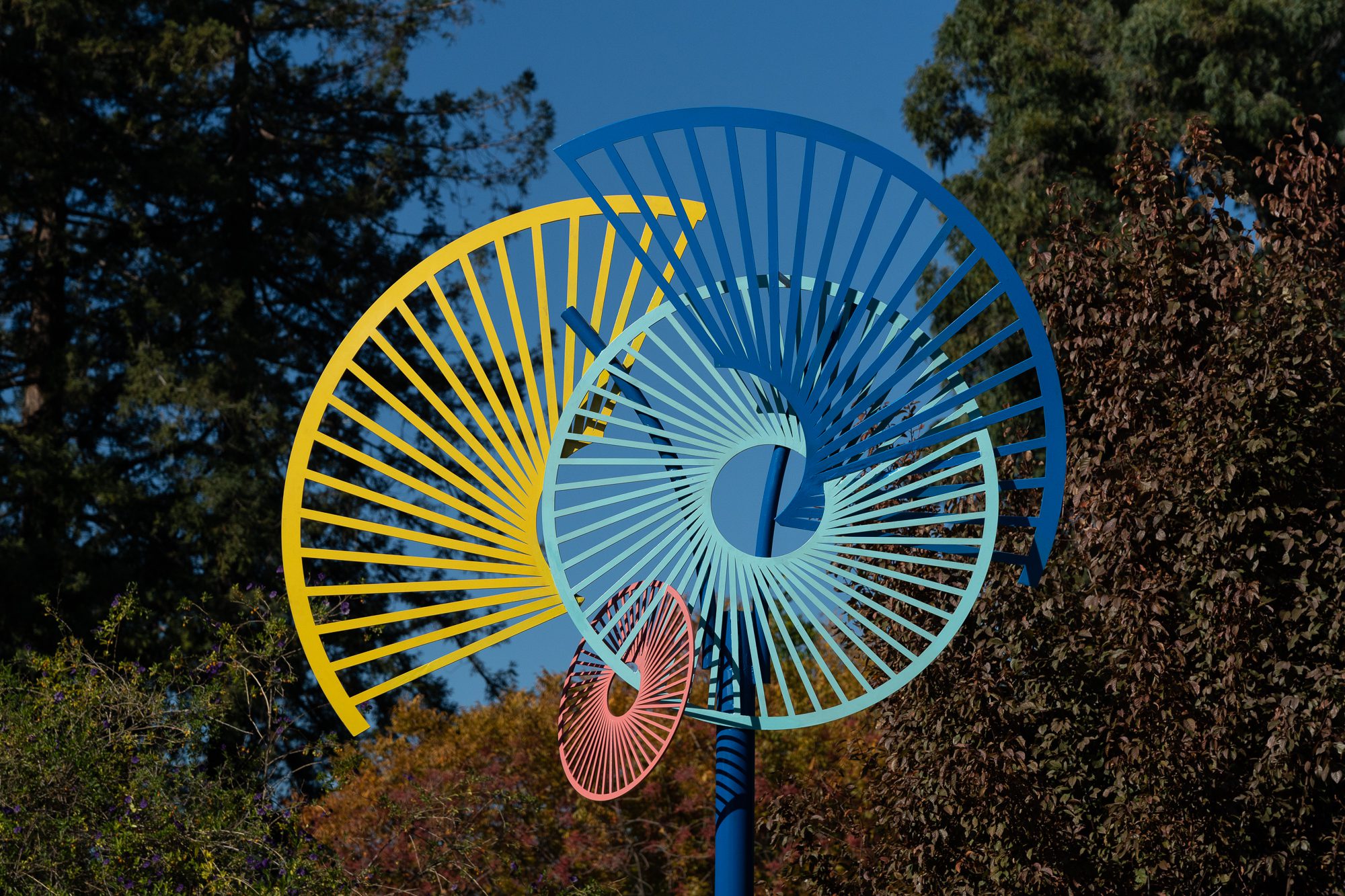
Palo Alto’s recent Code:ART, a free, biennial interactive media art festival, reminds us of the breadth, depth and impact of public art in cities across our county.
Code:ART transformed downtown Palo Alto into a vibrant playground of light, sound and imagination, reimagining the city’s downtown streets, plazas and alleyways into a luminous landscape.
Simply put, public art is art in public spaces. It is egalitarian, accessible and serves a wide range of community residents. While the term “public art” may conjure images of figurative bronze statues, today such art takes a wide range of forms, sizes and scales — and can be temporary or permanent. Public art might include murals, sculpture, memorials, integrated architectural or landscape architectural work, community art, digital media and even performances and festivals.
Art in public spaces plays a distinguishing role in our history and culture. It reflects and reveals our society, enhances meaning in our civic spaces, adds uniqueness to our communities and humanizes the built environment. Public art matters because our communities gain cultural, social and economic value through art.
But creating public art requires public sector leadership, effective policy development and implementation, authentic community engagement and a funding mechanism. Public art projects are typically managed by a municipal agency and are usually part of development or construction projects that are part of a larger urban development or cultural plan. In Santa Clara County, many of our cities have public art programs. They vary widely in scope, focus and impact, but all provide a resource to residents to engage with art in easy, accessible ways.
Cupertino recently revised its public art policy to remove barriers for developers to pay in-lieu fees. This means rather than installing public art in their own construction project, a developer can pay 1% of their construction budget into a fund which the city can then use for public art somewhere else in the city that best serves local residents. A “Percent for Art” ordinance is a policy specifying that a percentage of capital improvement project funds are set aside for public artwork. Some cities assess this percentage on government/public construction projects, but some municipalities are assessing commercial projects, bringing more benefits to local communities.
Morgan Hill has a public art program that continues to grow. Just a year ago, the city adopted a 1% public art fee on commercial development and is now developing a public art master plan to guide spending of future funds to meet long-term community goals. Downtown Morgan Hill is full of sculptural pieces like the large multimedia Tarantula sculpture on the Fourth Street garage, which celebrates the annual tarantula migration — actually the mating season — that takes place in the fall in the hills of Morgan Hill.
While San Jose currently manages more than 470 diverse artworks located at 150 sites throughout the city — projects that are recognized nationally and internationally — this collection is funded only through fees on city capital improvement projects. Imagine what a fee on commercial developments could make possible.
Sunnyvale has long been a leader in public art planning, as it was one of the first cities in the Bay Area to require a public art component for private development projects, including 2% of construction budget assessment. The entire collection is viewable online as part of the national Public Art Archive. A recent project is Sun Flair, a temporary sculpture program developed to connect local artists and their artwork with the residents of Sunnyvale. Twenty-six sculptures are on display in neighborhood parks for up to 24 months. The imagery represents each artist’s unique interpretation of Sunnyvale’s values and history.
It is worth noting all these projects would not be possible without the dedication of the many volunteers who serve on city arts commissions and public art committees. In our diverse county, with many perspectives on art, it is not an easy task to adjudicate and make recommendations to city councils about art installations. A big thank you to those folks!
I hope this inspires you to view and experience public art in your area by finding places to visit on your city website or by searching the national public art archives here. And you can encourage more of this type of accessible art that is open to all at all times of day by advocating for local policies that support resources for public art made for local residents. Perhaps you even want to apply to be on your city’s public art commission!
Alexandra Urbanowski is CEO of SV Creates, the state and county designated arts service organization and local arts agency for Santa Clara County. She serves on the leadership committee for the California Coalition of County Art Agencies and as a board member at the School of Arts and Culture at the Mexican Heritage Plaza. Her columns appear every first Wednesday of the month. Contact Alexandra at [email protected].
Leave a Reply
You must be logged in to post a comment.