



|
Getting your Trinity Audio player ready...
|
Tasheana Price used to sleep in the door frame of a building near the Palo Alto Caltrain station. Now, she works with homelessness nonprofit LifeMoves to manage volunteers at the organization’s drop-in service center downtown — the same place where she received case management herself about 10 years ago.
During the May 14 ribbon-cutting ceremony for Homekey Palo Alto, which is managed by LifeMoves, Price said she wished this type of interim housing was available when she was experiencing homelessness.
“This right here is monumental to me,” she said at the ceremony. “This is something that I prayed for, even though I couldn’t have it.”
The Homekey site at 1237 San Antonio Road is the first interim housing project of its kind in Palo Alto, offering 88 apartments for families and individuals experiencing homelessness. In addition to on-site amenities like laundry and play areas for children, residents will be able to access case management services to help secure permanent housing, jobs, healthcare and more.
For the city, the Thursday event marked the completion of a project that officials first proposed nearly five years ago and that has only grown urgent in the past year, as the city has seen its population of homeless individuals more than double. Most of them live in oversized vehicles, dozens of which have been parked for months next to the Homekey site.
The new complex stands on a city-owned property near the Mountain View border. In addition to providing the land, Palo Alto will continue to pay $1 million annually to help fund operations, Mayor Vicki Veenker said at the ceremony.
Residents were invited on guided tours of some of the apartments on Thursday, which feature simply furnished bedrooms, bathrooms and kitchens. Several city and county officials participated, including Veenker, District 5 Supervisor Margaret Abe-Koga and numerous city councilmembers.
“Look around right now and imagine the life that will soon be at this site,” Veenker said. “Families will be able to rest safely, stable enough to get back on their feet and reenter permanent housing.”
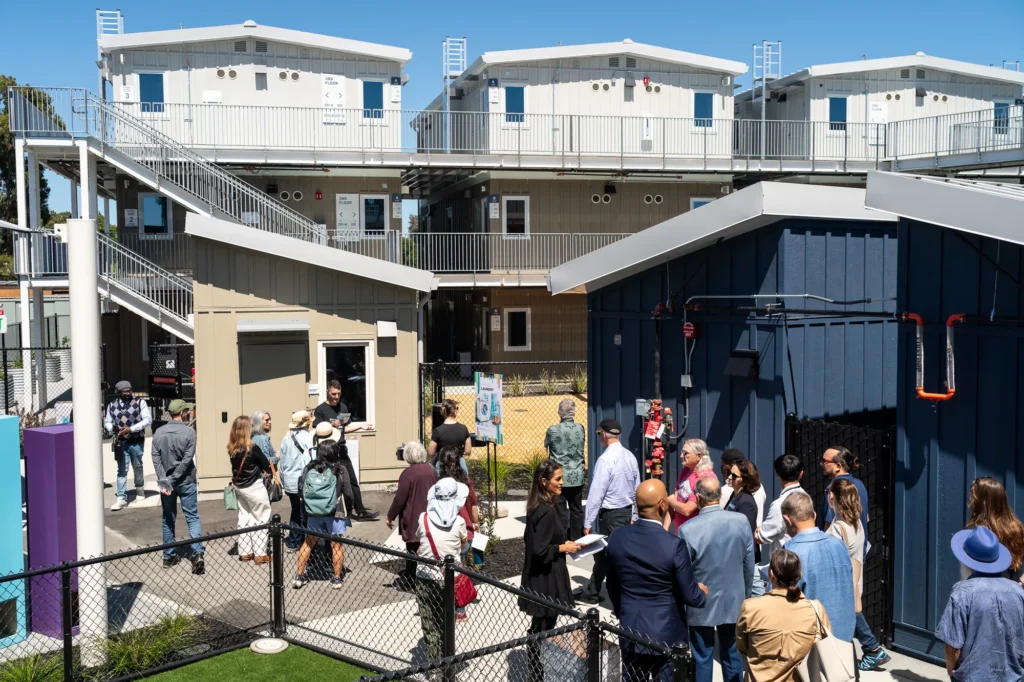
On the outside, the modular homes exude a vaguely industrial feel, with metal elevated walkways and a neutral color palette on the building facades. Tall black fences enclose the entire site and separate certain amenities, like the children’s play area and the dog run, from the walkways. LifeMoves representatives said the fences are intended to support the safety of residents, especially small children.
It’s a stark contrast to the Baylands Nature Preserve just down the street, where future residents will be able to walk along the shoreline and observe birds, fish and other animals in their natural habitat. To the west, the Santa Cruz mountains tower in the distance.
The inside of the apartments boast modern appliances and design elements with bright interiors. A family-sized apartment had one primary bedroom with an en-suite bathroom and a second bedroom furnished with a bunk bed for children. A smaller studio intended for one or two people features a bed, desk, full bathroom and kitchenette with a microwave.
Instead of traditional keys, each of the 88 apartments has a password-protected keypad.
Several curious visitors spoke highly of the homes throughout the guided tours, and one tour guide from LifeMoves joked that the apartments are “nicer than his place.”
Residents are expected to move in by the end of June, according to LifeMoves spokesperson Maria Prato. Many of them are being funneled from another interim housing location at a hotel in Sunnyvale, where LifeMoves has been hosting future Homekey residents in order to comply with state deadlines surrounding occupancy.
Homekey projects receive funding from the state Housing and Community Development department, and the one in Palo Alto is no exception. However, Homekey Palo Alto has been beset by numerous construction delays, mostly due to a dispute between the site’s various subcontractors, public records indicate.

Construction began in October 2023 to the tune of $37.2 million total, with about $26 million coming from the state and various city and county sources contributing the rest. It was anticipated to be completed within 12 months, but the state granted an extension to spring 2025. Construction was not actually finished until this month.
As previously reported, several final tasks such as painting, clean-up and fire alarm repairs were delayed as a result of the contractor dispute. Construction at Homekey Palo Alto was led by Devcon Construction, Inc., which employed subcontractors ARECO Construction and Volumetric Building Companies (VBC). ARECO halted construction work on site in November 2025, citing nonpayment from VBC.
City Manager Ed Shikada wrote in an email to the City Council in November that the payment disputes totaled $1.4 million, but Devcon CEO Gary Filizetti disputed that number last month, stating the various contractors will reach a final dollar amount after construction is completed.
Devcon Vice President Tony Taormino said in an interview at the Thursday ceremony that there were no updates on the subcontractor issues.
But due to the numerous delays, LifeMoves has been facing mounting pressure to receive a certificate of occupancy by the state deadline. As a workaround, LifeMoves secured a hotel in Sunnyvale and converted dozens of rooms into temporary supportive housing. The state HCD allows Homekey projects to obtain at least 90% occupancy at a temporary, off-site location to accommodate delays in the actual Homekey project.
According to public records, LifeMoves barely made the Feb. 6 state deadline to house 58 single adults and 22 families in Sunnyvale. All residents will be offered a spot at Homekey once it opens for move-in.
“We’re moving from borrowed rooms to a place designed with intention and real experience, from where urgent needs (are met) in the moment to creating a setting where people can stabilize and begin their next chapter,” LifeMoves interim CEO Nick Hodges, who last month replaced departing CEO Aubrey Merriman, said.
Two residents of the Sunnyvale hotel, Paul and Sheryl, said they can’t wait to move into an apartment at Homekey Palo Alto. The couple, who asked only to be referred to by their first names for safety reasons, have both experienced homelessness on and off for years.
Sheryl said she is especially excited about the fact that the apartments are brand new, and she and Paul will be its first-ever occupants.
The couple is expected to move in sometime next month, but for now, Sheryl said they are “just taking it one day at a time.”
Future Homekey residents are not expected to stay there forever. Between the case management and other services, LifeMoves hopes to eventually transition residents into permanent housing. The organization hopes to serve more than 200 people per year through the Homekey program.

Leave a Reply
You must be logged in to post a comment.