


|
Getting your Trinity Audio player ready...
|
Faced with a punishing budget shortfall, San Jose voters are being asked to increase the city’s hotel tax by 2% on the June 2 primary election ballot.
San Jose’s Measure A, which will increase the city tax levied on hotel guests from 10% to 12%, has opened up a familiar debate for the consistently cash strapped metro. On one hand, supporters argue the city must find ways to generate more revenue or face dramatic public service cuts. On the other hand, opponents contend adding any more taxes to to the city’s already struggling tourism industry will weigh down the local economy.
Adding extra urgency to the debate, San Jose officials laid out dire warnings this week that if voters reject the proposed hotel tax, the city will be forced to make deep cuts to a range of core services including public safety and the library system.
The ballot measure needs a simple majority to pass and would take effect Oct. 1 if approved. The bump to the tax on visitor stays in local hotels, also known as a transient occupancy tax, would generate roughly $10 million in additional revenue each year, according to city estimates. The money would go to the city’s general fund, leaving it up to future City Council deliberations to determine how it will be spent.
Measure A has drawn broad support, including from the Santa Clara County Democratic Party as well as Mayor Matt Mahan, who signed onto the argument in favor of the measure that appears in the Santa Clara County voter information guide.
The measure’s support spans across San Jose’s rival business and labor political coalitions, having won endorsements from the San Jose Chamber of Commerce as well as the South Bay Labor Council.
“It’s important that Measure A passes because the city general fund needs immediate relief to avoid layoffs and protect core services,” South Bay Labor Council Executive Officer Jean Cohen told San José Spotlight.
The response from other business groups has been muted. Representatives for the Silicon Valley Business Alliance as well as Silicon Valley BIZ PAC told San José Spotlight their organizations have not taken a position on the matter.
One exception is the Silicon Valley Taxpayers Association, which has emerged as a vocal critic of the proposal.
“Why should people who come to Silicon Valley for business or pleasure be taxed to do so?” the group’s president, Mark Hinkle, told San José Spotlight. “Isn’t that discouraging businesses coming to California, in Silicon Valley in particular. Why would we want to do that?”
He noted the added levy would be another layer on top of the last Measure A on Santa Clara County’s ballot, a five-eighths-cent sales tax increase approved by voters last November that recently went into effect.
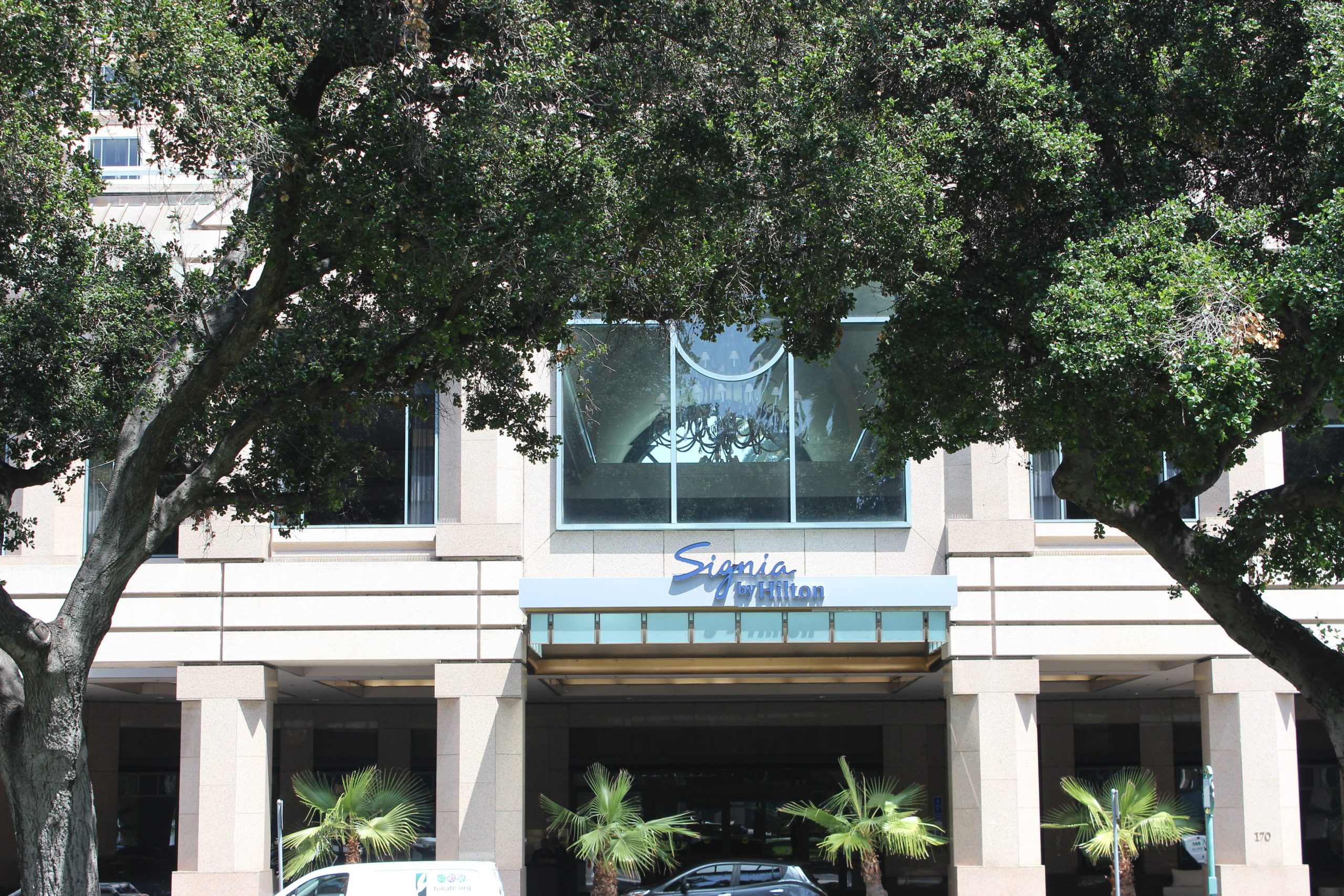
But supporters of the proposed hotel tax said even at 12%, the levy would still remain below levels imposed in other major cities. San Francisco and Oakland have set their hotel taxes at 14%, according to a city memo. San Jose hotels already face a number of fees that substantially increase their effective tax rate.
A representative for Team San Jose, which promotes tourism and manages city-owned cultural and convention facilities, declined to comment, citing a policy against remarking on political measures.
San Jose’s precarious budget situation came into stark relief this week as councilmembers reviewed City Manager Jennifer Maguire’s recently released budget proposal for the coming fiscal year.
The budget plan, which balances a $50 million deficit, already includes about $19 million in cuts to city services. But budget officials said the fiscal pain would get dramatically worse should voters reject Measure A.
Contingency plans aren’t pretty
Under a contingency plan outlining such a scenario, San Jose would be forced to eliminate nearly 50 full-time positions. This would mean eliminating Sunday hours at branches of the San Jose Public Library, and rolling back a grant program supporting youth summer programming. In addition, the San Jose Police Department would also need to cut all downtown officer foot patrols.
Meanwhile, with San Jose facing more budget deficits in the years to come, Cohen said Measure A is just the first step in a broader conversation the city must have about how it can generate more revenue.
“The public wants those benefiting most from our economy to contribute fairly to the communities and workforce that make their success possible,” she said.
Over the course of this week’s budget talks, city leaders expressed alarm over the uncertainty presented by the approaching Measure A vote. Vice Mayor Pam Foley noted such uncertainty is compounded by several other looming budget wildcards, such as a state crackdown on local card rooms, which could harm an industry that provides a crucial source of tax revenue for San Jose.
“I am very concerned about the list of question marks for our big-ticket income generators,” Foley said during a Wednesday budget study session. “If they don’t come through, we have to go to a contingency plan, which is very concerning and will keep us awake at night.”

In February, during earlier deliberations over the hotel tax proposal, some local civic leaders objected to the measure on the grounds that it does not include any guarantees the money will be reinvested into the city’s hospitality or arts sectors. Presently, 60% of the city’s hotel tax is earmarked for such purposes. The rest goes directly to the city’s general fund.
San Jose Chamber of Commerce CEO Leah Toeniskoetter is among those who voiced concerns. In explaining her organization’s eventual endorsement of Measure A, Toeniskoetter said the local economy relies upon a stable city government to thrive.
“We need to be able to provide the police and the fire and clean and safe streets for our sports and entertainment, our visitor experience, our tourism opportunities — to really continue to grow,” Toeniskoetter told San José Spotlight.
Contact Keith Menconi at [email protected] or @KeithMenconi on X.
Leave a Reply
You must be logged in to post a comment.