


|
Getting your Trinity Audio player ready...
|
Although Caltrain is looking down the barrel of fiscal disaster, agency representatives who spoke to the Palo Alto City Council on Monday highlighted their recent efforts to raise revenues and lauded the city as a regional model for public transit partnerships in the run-up to a critical vote.
Palo Alto leaders have already endorsed the Regional Transit Measure, a measure on the ballot in five Bay Area counties this November that would fund Caltrain, VTA, BART and SamTrans among other transportation agencies. Santa Clara, San Mateo, Alameda and Contra Costa counties will decide on a 0.5% sales tax increase to fund public transit agencies, while people in San Francisco will consider a 1% sales tax.
The measure could generate as much as $1 billion in revenue annually, according to Connect Bay Area Transit, a committee that organized the ballot measure earlier this year and is campaigning for its success.
Among the agencies that would receive funding if the measure passes, Caltrain is one of the most popular among voters and riders, according to the agency’s Chief of Staff Casey Fromson. She told the council that 82% of voters have a favorable opinion of Caltrain, as do 91% of riders — support percentages that are “up there with libraries and babies,” she added.
“If you are not on Caltrain, you appreciate the people that are, because we are removing the equivalent of three freeway lanes worth of traffic every single day,” Fromson said.
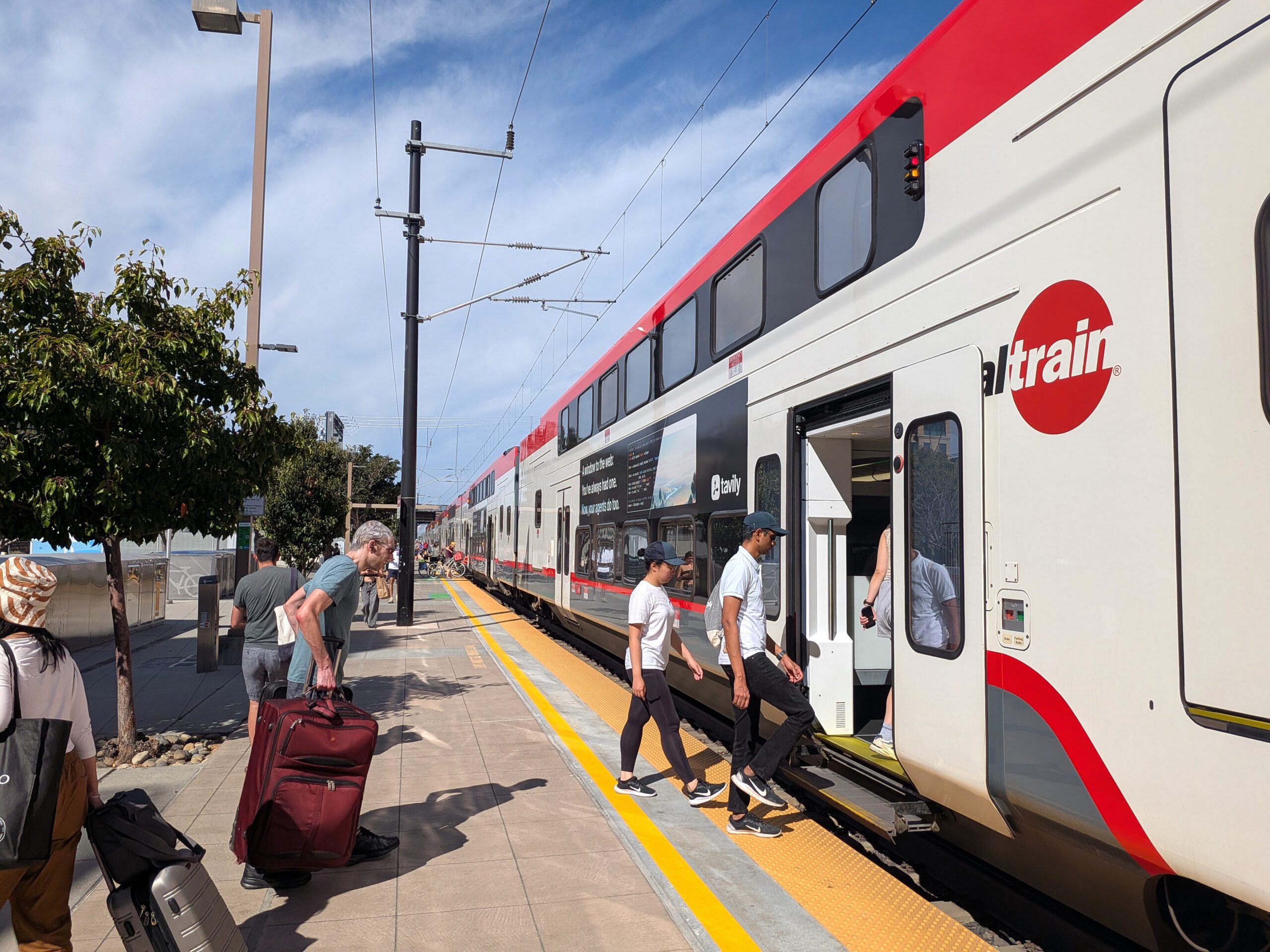
Caltrain is the fastest growing transit agency in the U.S. and has recovered significant ridership compared to COVID-19 pandemic lows, Fromson added. The electrification of the trains saw far more riders, in part due to more reliable and frequent train service, she said.
From August 2024, prior to the electrification project, to August 2026, ridership in Palo Alto nearly doubled, according to Caltrain. Across the entire transit agency, ridership increased by 124%, from 643,000 riders to 1,446,000.
“I’ve seen that riders on the electrified trains get even more excited than is justified, and it’s a form of irrational exuberance,” said Councilmember Pat Burt, who serves as vice chair of the Caltrain board of directors. “I don’t quite know what to make of it.”
Despite the success of the electrification program, Fromson explained that Caltrain’s funding model has changed dramatically since the pandemic began. In 2019, fares made up 70% of the agency’s revenue, but remote work and hybrid commuting patterns mean that fare collection is only 33% of revenue today.
Fromson said the agency is already trying to save costs internally, while at the same time exploring non-fare revenue avenues such as advertising, parking fees and transit-oriented development along the rail corridor.
A recent example is the fact that Caltrain closed the Stanford station this year, which has previously been used only for home football games because it is slightly closer to the stadium than the downtown station. Caltrain spokesperson Dan Lieberman previously told Palo Alto Weekly that the Stanford station also requires additional staffing and funding to operate because it is not ADA compliant and doesn’t have ticket vending machines or Clipper card readers.
Caltrain also recently announced a partnership with Waymo, leasing 40 parking spaces — 10 of which are at the California Avenue station — to the autonomous vehicle company. Fromson said similar partnerships are one of the funding strategies that the agency is turning to instead of fares.
Without the regional transit measure, Caltrain’s $75 million operating deficit could translate to fewer trains and no weekend service at all, Fromson said. More than one third of all stations could be closed and the last trains would run at 9 p.m. instead of midnight, she added.
“If we do these cuts, this is the downward spiral: You have less service, fewer riders, less revenue, and it makes it a really difficult cycle to reverse,” Fromson said.
Palo Alto in particular has a lot to lose if the cuts go into effect: The University Avenue station is the second-most popular in the entire system. Burt noted that Palo Alto punches far above its population size in terms of Caltrain ridership — for example, the city has roughly twice the number of people boarding compared to Diridon Station in San Jose.
In light of the revenue shortfall, Burt said all transit agencies, not just Caltrain, need to become financially sustainable absent the COVID-19 era operating subsidies from state and federal government agencies, which have dried up in the past few years.
He also noted that the city provides free Caltrain passes to low-income workers through the nonprofit Palo Alto Transportation Management Association, and 75% of all GoPasses in the system come from Palo Alto.
When the city was considering cuts to PATMA during the budget season, many small business owners came forward to express their appreciation and reliance on the GoPasses because the program opened up public transportation options for commuting employees, Burt added.
His colleagues agreed that Caltrain remains a critical transportation option for local residents and workers and praised the agency for exploring other ways to raise money.
“It’s laudable that, in addition to the RTM on the ballot, to see the non-fare-revenue strategies,” Mayor Vicki Veenker said. “I appreciate the fresh look at things.”

Leave a Reply
You must be logged in to post a comment.