


|
Getting your Trinity Audio player ready...
|
Transit advocates say they’ve surpassed their signature-gathering goal to put a sales tax on the November ballot, which would raise $1 billion annually for public transit service across five Bay Area counties and could save some stations from closure.
Representatives for the Connect Bay Area campaign on Tuesday said canvassers gathered nearly 306,000 signatures — roughly 120,000 more than the 186,000 required — to provide long-term operational funding for transportation agencies including VTA in Santa Clara County. The sales tax would amount to a 0.5% increase in the South Bay, where some cities already have high sales tax rates. Approximately $264 million would go to VTA annually until the tax ends after 14 years.
The signature gathering campaign utilized paid workers and volunteers. Each signature will be reviewed by elections officials for each of the five counties before the effort can qualify for the Nov. 3 midterm election ballot. Advocates expect to know if the measure qualifies in about a month, but said it depends county-by-county.
“(Collecting more signatures than required) shows the level of enthusiasm and the level of love that our community has for public transit, an under-discussed but key part of the Bay Area’s identity,” Harry Neil, a leader of the volunteer signature gathering campaign in the South Bay, told San José Spotlight. “We saw this not only as an opportunity to help save transit, but also to build a wider of culture of advocates for transit in the Bay Area.”
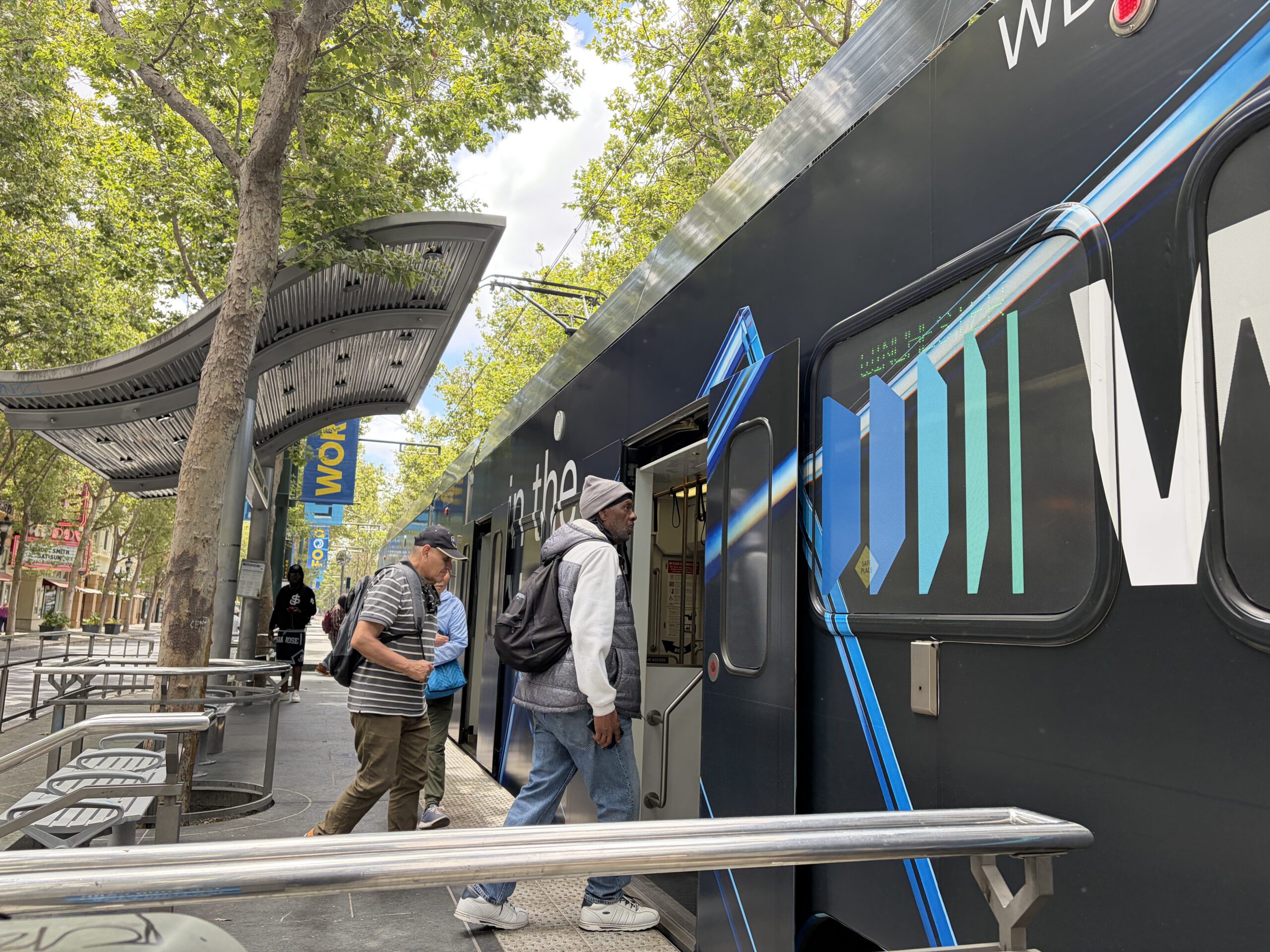
Agencies such as VTA and BART are the main ways to get around on public transit, but are struggling with multiyear budget deficits.
VTA surpassed record ridership expectations with Super Bowl 60 in February, but projects a $15 million deficit by 2027. BART on April 17 reported a 10% year-over-year surge in trips this month, but faces an annual structural deficit of $350 million to $400 million. The agency has warned it might close 15 stations with a 70% reduction in service if the proposed tax measure fails.
A November poll ranked Santa Clara County as having the lowest voter support for the initiative out of all five counties, which also includes Alameda, Contra Costa, San Mateo and San Francisco.
San Jose resident Eden Bingioba said he takes the VTA bus twice a day to and from work, and otherwise gets around on foot because he lives downtown. He said the burden of funding transit should fall on the wealthy.
“Things are already expensive. Gas is expensive. Rent is expensive. We already get taxed a lot,” Bingioba told San José Spotlight. “Adding another (tax) would be too much. The higher ups should pay for it. The wealthiest people in this region can definitely afford it.”
VTA’s strategy for supporting the proposed sales tax increase is to give voters a spending plan before Election Day. The public transit agency is drafting a list of possible projects and working to outline how revenue from the five-county sales tax, if approved, would be used. The VTA board of directors is expected to adopt a formal plan in June.
Sergio Lopez, chair of the VTA board and a Campbell councilmember, is optimistic that the volunteer component of the signature gathering campaign ensures the initiative qualifies for the ballot. Advocates said the Bay Area-wide campaign used roughly 1,000 volunteers.
“There are obviously a lot of measures competing locally, statewide, for places on the ballot and mostly those use paid signature gatherers. We had a largely volunteer effort,” Lopez told San José Spotlight. “We’re getting people who really care. I think it bodes very well.”
Silicon Valley Taxpayers Association board member Omar Chatty anticipates fighting the measure if it qualifies. He said transit agencies should cut down on spending before asking taxpayers for their wallets.
“The taxes are too high already and it’s time for public agencies to do what private businesses do, and they need to look at their cost structure and see if they’re getting the most bang for their buck,” Chatty told San Jose Spotlight.
A study of four Bay Area transit agencies — not including VTA — argues officials have already identified $1 billion in savings over recent years.
Jean Cohen, a Connect Bay Area committee member and executive officer of the South Bay Labor Council, said the signature milestone reflects a bipartisan understanding of public transit’s importance to the economy.
“This is the perfect example of recognizing we all need to be leaders — to use our resources and relationships — to do something important not only for the transit system, but all Bay Area residents who would be impacted by the potential disruption,” Cohen told San José Spotlight.
Contact Brandon Pho at [email protected] or @brandonphooo on X.
Leave a Reply
You must be logged in to post a comment.